Ruines sans référent
Le document, l’archive et l’effacement — série Ukraine (2022)
Un document de quoi ?
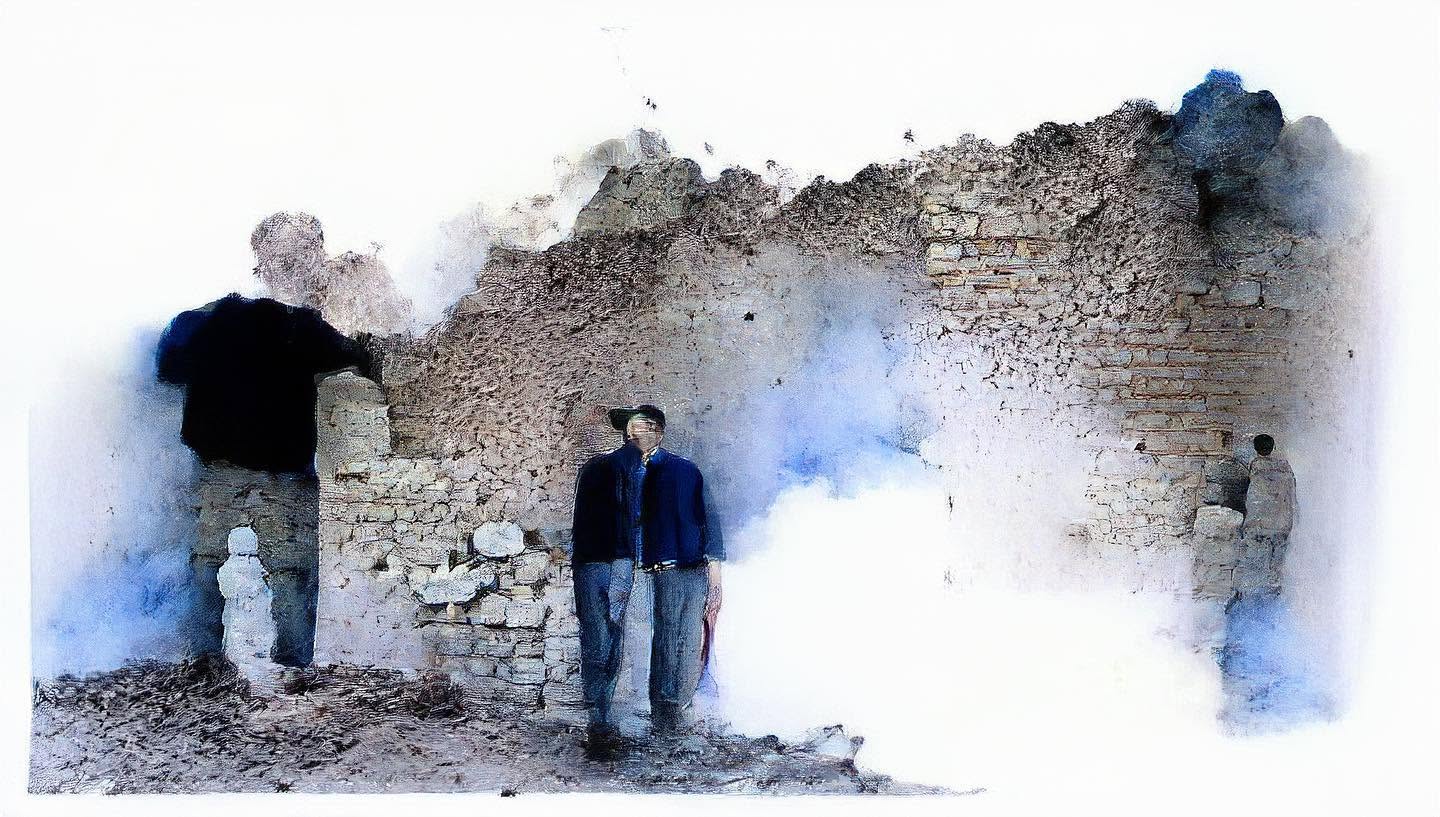
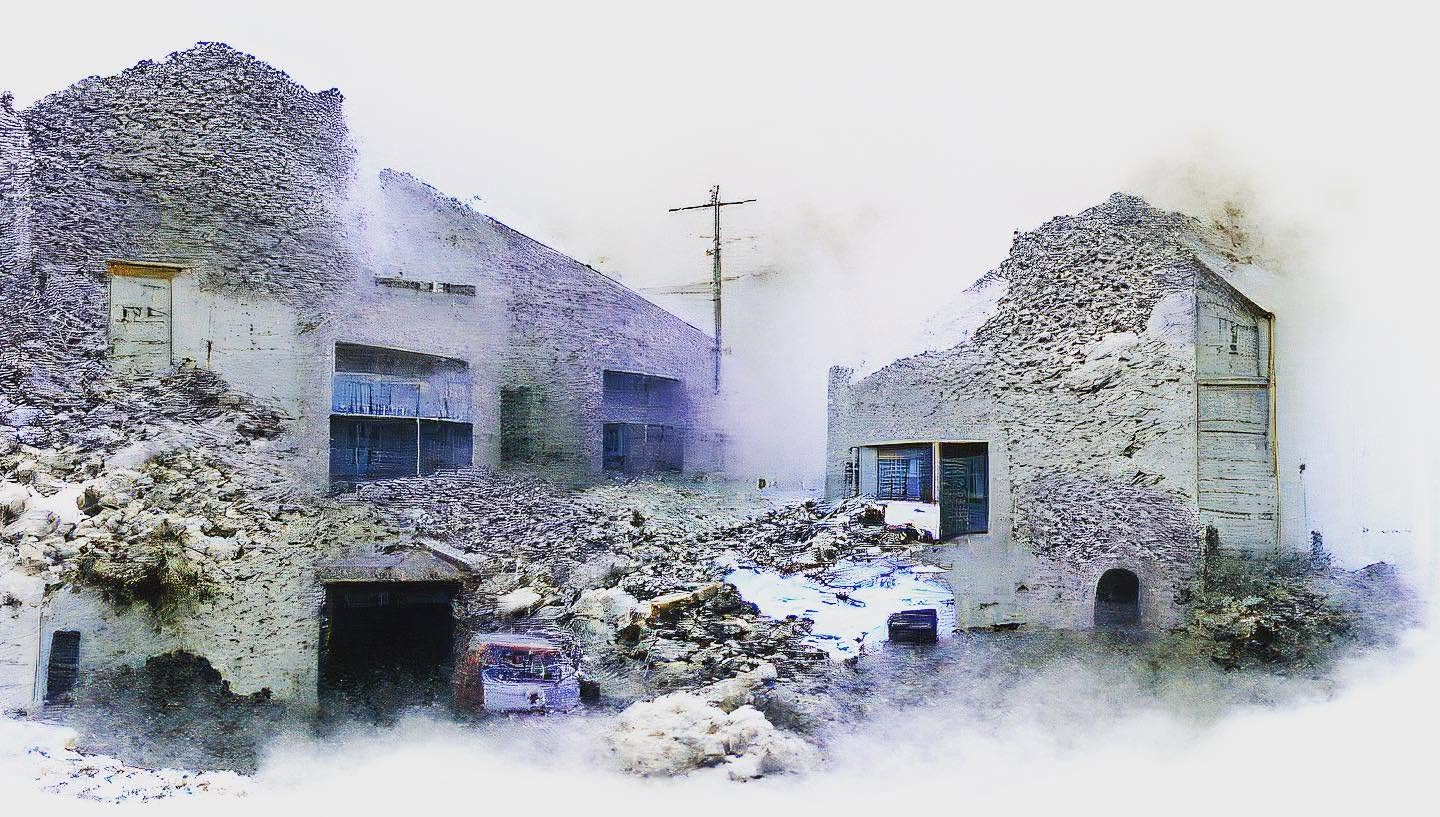
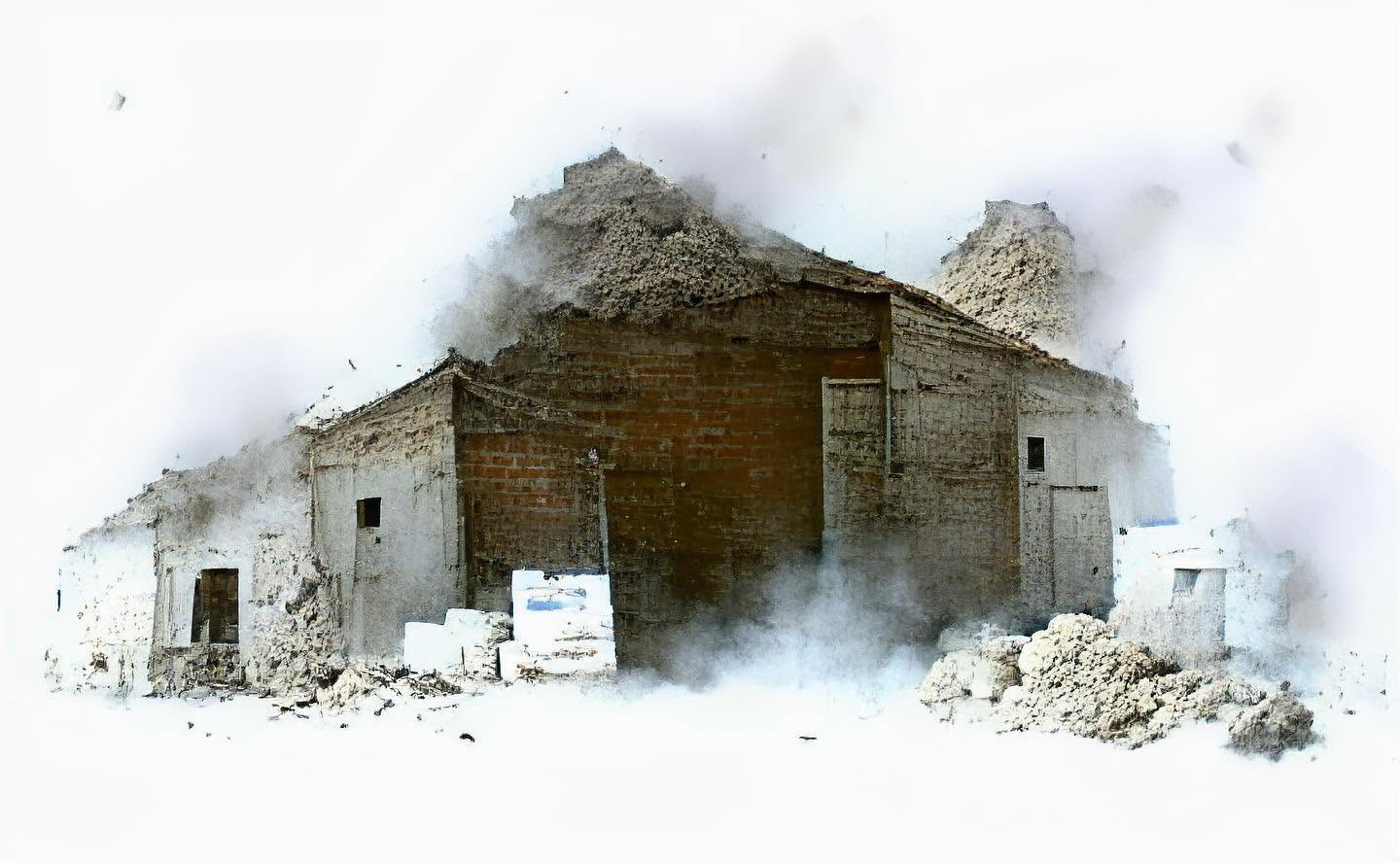
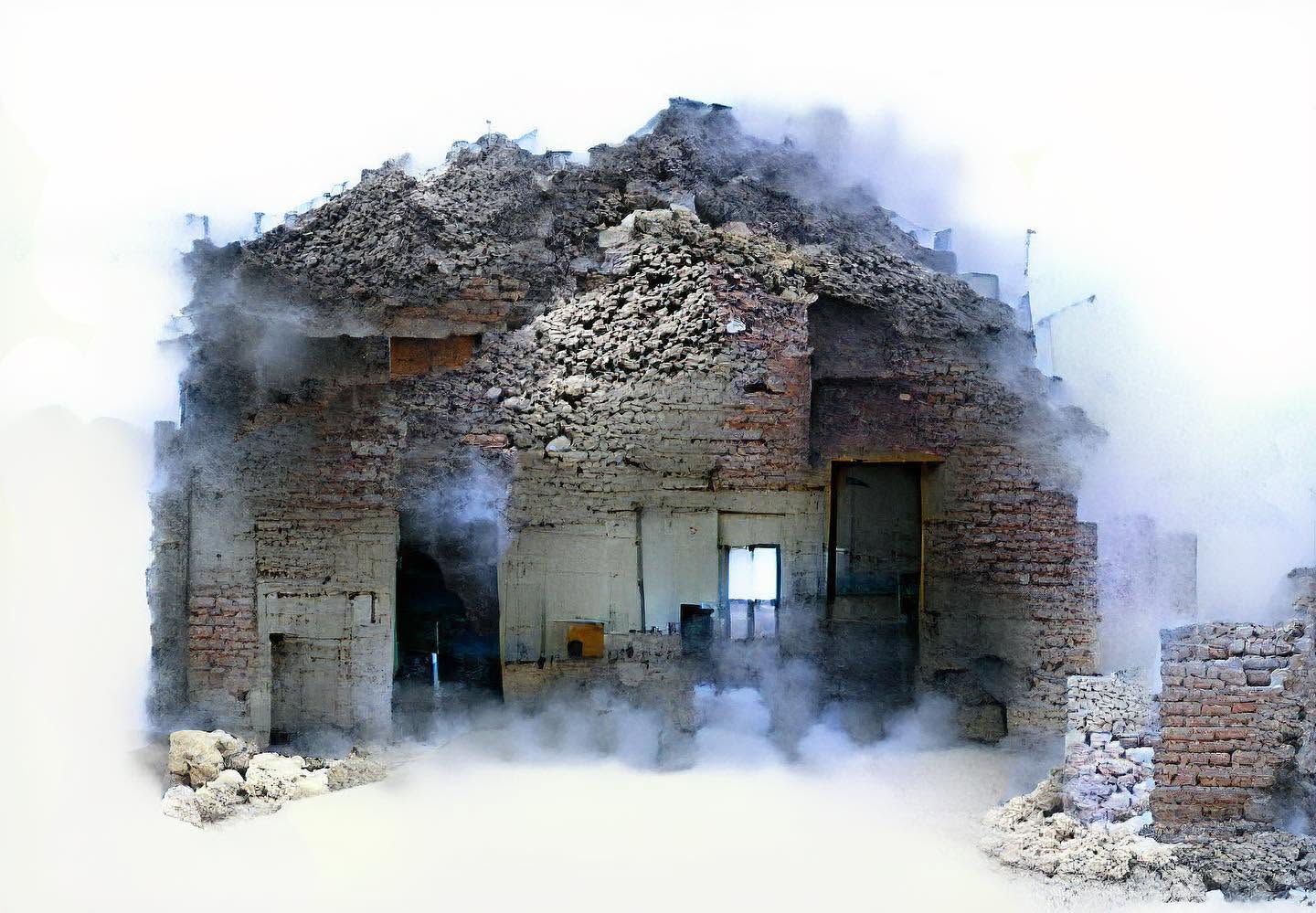
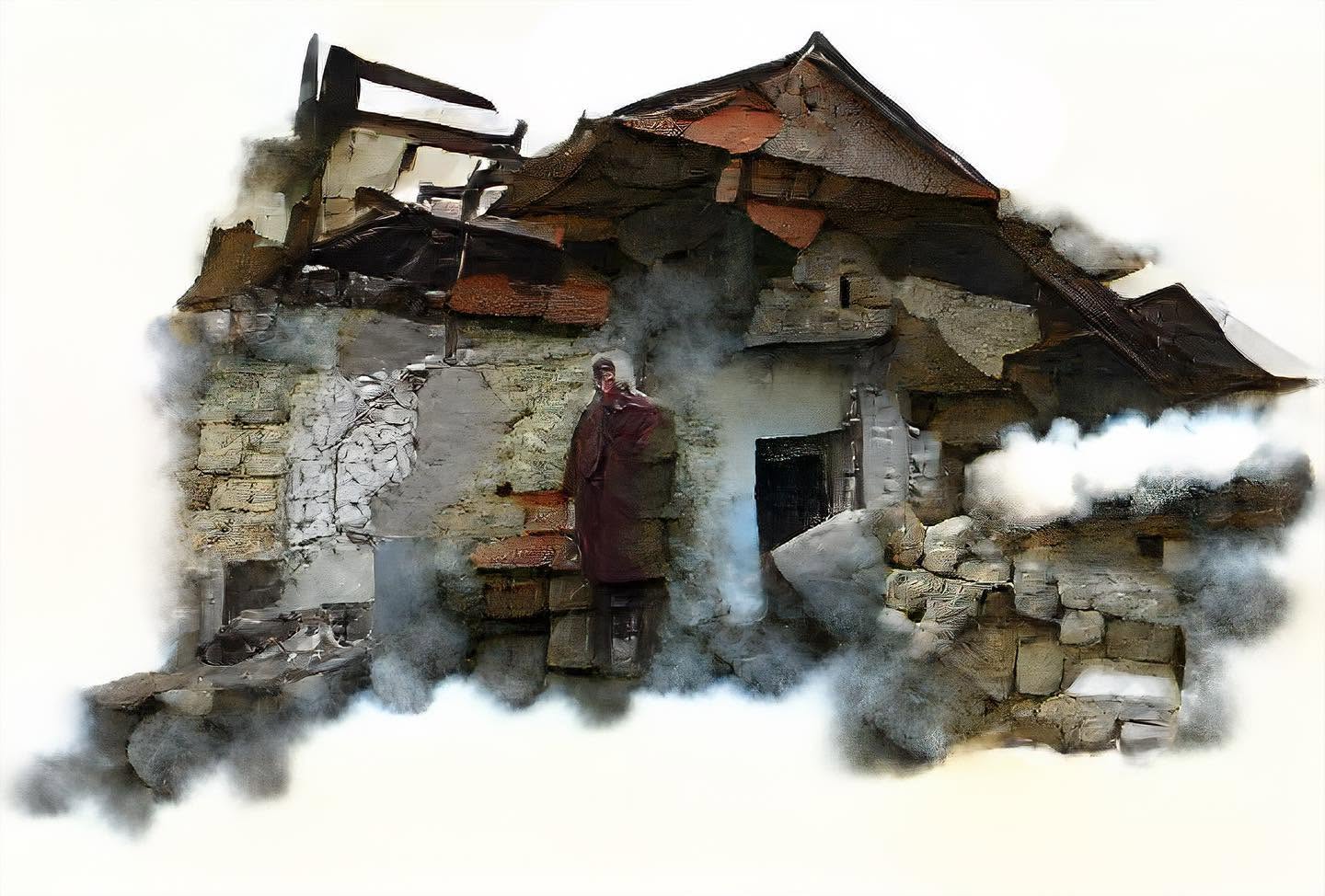
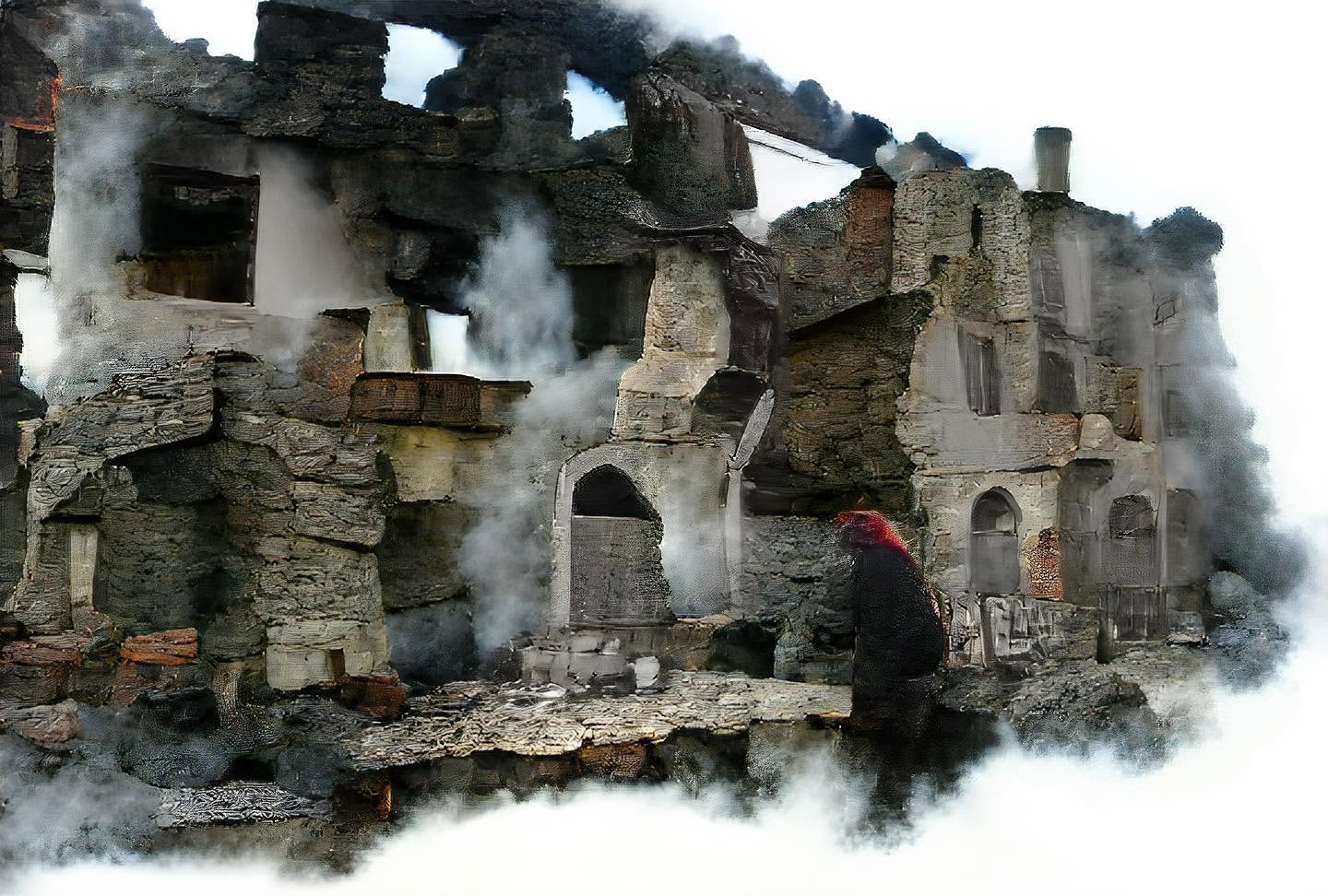
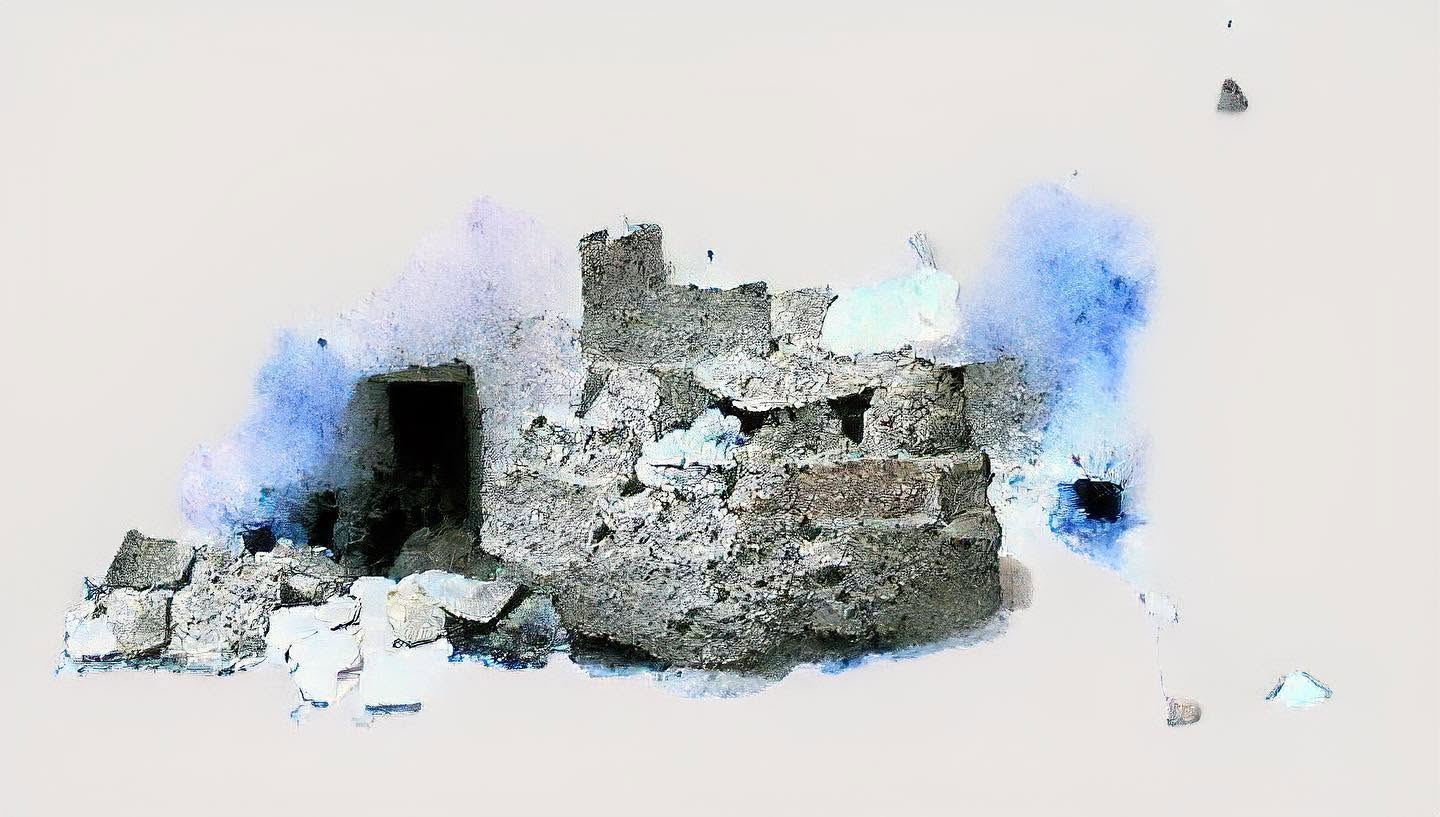
J’ai commencé cette série en 2022, dans les premières semaines de l’invasion à grande échelle, à partir de photographies de destructions causées par l’armée russe. Le procédé tient en trois opérations : entraîner un modèle sur ces photographies de ruines ; générer à partir de lui des images de destruction, d’abord très brouillées ; puis effacer, par une seconde intervention algorithmique, les zones devenues trop illisibles. Ce qui subsiste — un édifice éventré qui émerge d’un fond presque vierge, cerné de coulées bleues, mangé de blanc sur ses bords — n’est plus une photographie de guerre. C’est autre chose, dont le statut est précisément la question : un document de quoi ?
Les images ont tous les signes du document : l’iconographie du sinistre, les murs effondrés, l’embrasure noire d’une porte, les gravats, le poteau électrique resté debout. Elles convoquent ce que Barthes appelait l’« effet de réel », ce surcroît de présence par lequel un détail atteste « nous y étions ». Et pourtant aucun photon venu d’un lieu réel n’a jamais touché ces images. Elles documentent une destruction qui a bien eu lieu — celle de l’Ukraine — sans documenter aucune destruction en particulier. Elles sont des ruines sans référent. La série ne porte pas tant sur la guerre que sur ce qui arrive au document quand il traverse un modèle génératif.
Le document métabolisé
La première opération transforme la nature même de l’archive. En entraînant un modèle sur un corpus de photographies de destruction, je ne constitue pas une collection : je dissous des documents dans une disposition. Les images réelles ne sont plus consultables comme telles ; elles ont été métabolisées en poids, sédimentées dans la couche lente du modèle — ce que j’appelle la bi-sédimentation, où l’archive documentaire devient une capacité à générer plutôt qu’un stock à conserver.
C’est exactement le renversement que pensait Derrida dans Mal d’archive : l’archive n’est jamais un simple dépôt du passé, elle est d’abord consignation, geste qui rassemble et, ce faisant, sélectionne, exclut, détruit. Il y a au cœur de l’archive une pulsion qui travaille contre elle, une anarchive. Le modèle génératif porte cette logique à son terme : il n’archive plus des images, il archive une tendance — « la destruction » comme catégorie latente, mémoire sans souvenirs. C’est ce que je nomme mémoire allogénétique, une mémoire de ruines venues d’ailleurs, qui n’appartiennent à personne, et inconscient algorithmique, ce savoir tacite de la catastrophe que le réseau a contracté sans jamais l’avoir vue. Là où Lev Manovich décrivait la base de données comme forme symbolique de notre époque, le modèle marque un pas de plus : non plus une base que l’on interroge, mais une disposition qui répond. L’archive a cessé d’être lisible pour devenir générative.
La destruction sans référent
La deuxième opération produit l’image, et avec elle la crise du document. Ce que le modèle restitue, ce n’est aucune ruine datée : c’est une synthèse statistique de toutes celles qu’il a ingérées, une destruction en général qui n’a ni lieu ni heure. Le brouillage initial — le bruit dont l’image émerge — est l’index honnête de cette non-référence : l’image avoue qu’elle ne renvoie à aucun instant capté.
Ici se joue la perte de l’indice. La photographie tirait son autorité documentaire de l’indexicalité : une empreinte lumineuse du réel, au sens de Peirce repris par Rosalind Krauss. L’image générée rompt ce lien — elle a l’apparence de l’indice sans en avoir le fondement. Elle relève de ce que les théories post-photographiques (Manovich, Mitchell) annonçaient : une image qui ressemble à une photographie mais n’en partage plus l’ontologie. Et pourtant je ne crois pas qu’elle ne documente rien. Elle documente autrement : non l’événement dans sa singularité, mais sa rémanence achronique, la persistance d’une destruction soustraite à la chronologie. C’est la ruine au sens où Walter Benjamin la pensait — non l’accident d’une histoire, mais la forme même que prend l’histoire, l’allégorie d’un temps qui ne se totalise pas, ce que contemple l’ange tourné vers l’amoncellement des décombres.
La photographie d’après-coup — ce que David Campany a nommé late photography, l’image du lieu une fois l’événement passé, trace de la trace — trouve ici sa version paradoxale : un après-coup sans coup, une scène d’aftermath dont l’instant n’a jamais été photographié. La texture granuleuse, presque géologique, que prend la matière détruite n’y est pas un défaut : elle fait de la ruine récente une ruine immémoriale, comme si la destruction avait toujours déjà eu lieu.
L’effacement rendu visible
La troisième opération est la plus singulière, et c’est elle qui fait basculer la série du côté de l’œuvre. Plutôt que de conserver la totalité de l’hallucination, j’efface — par une seconde IA — les zones devenues trop brouillées. Ce qui reste de blanc dans l’image n’est donc pas un fond : c’est la trace de ce retrait, la forme visible de ce que la machine n’a pas pu résoudre en image. L’effacement n’est pas masqué ; il est exposé comme effacement.
L’image porte alors sa propre lacune inscrite en elle. C’est, plastiquement, la leçon de Didi-Huberman : l’image n’est ni toute-puissante ni nulle, elle vaut « malgré tout », justement parce qu’elle assume son manque au lieu de le combler. Le blanc qui dévore les bords, les fragments orphelins qui flottent sans sol, les coulées bleues qui contaminent le photographique d’une matière picturale : tout cela inscrit dans l’image l’aveu de sa fabrication et de sa défaillance. L’image confesse qu’elle est un reste.
Et c’est ici que l’archive révèle sa violence propre. Tout document est le produit d’un effacement — de tout ce qui n’a pas été retenu, cadré, conservé. En rendant l’effacement visible, la série ne montre pas seulement des ruines : elle montre l’archive en train de ruiner. Le blanc est l’anarchive devenue image. Il y faut entendre quelque chose du désastre selon Blanchot : non l’événement représentable, mais ce qui ruine jusqu’à la possibilité de la représentation, et n’en laisse paraître que le bord.
Ruine de la ruine
Ces images sont doublement ruinées : elles représentent des ruines, et elles sont elles-mêmes des images ruinées — fragmentées, effacées, dissoutes dans le blanc. Le médium accomplit son sujet. C’est pourquoi la série n’est pas un document de la guerre en Ukraine, mais un document de ce qu’il advient du document à l’ère des modèles génératifs : sa métabolisation en disposition, la perte de son indice, l’effacement qui le constitue. Une archive du désastre au sens fort — où l’archive elle-même est exposée dans son désastre.
Reste alors une fidélité paradoxale. Je ne suis pas fidèle à l’apparence de l’événement — je n’en restitue aucun instant vrai. Je suis fidèle à sa disparition : au fait qu’une part de ce qui a été détruit ne sera jamais documenté, et que le document, là où il existe, est lui-même fragile, partiel, voué au retrait. Ce n’est pas un pararéalisme consolant, un double rassurant du réel ; c’est un réel à côté du réel qui tient le manque ouvert.
La série Ukraine forme ainsi la première station d’un trajet. De la ruine métabolisée et effacée (le document qui se défait dans la machine) à l’image de l’événement jamais documenté (la série Archive impossible, sur Gaza), une même question se poursuit : que peut l’image quand le document fait défaut, ou se défait ? Non pas combler l’absence par la simulation, mais en faire une iconologie — une pensée de la lacune et de l’intervalle.
// ENGLISH //
Ruins Without a Referent
The Document, the Archive, and Erasure — Ukraine series (2022)
A Document of What?
I began this series in 2022, in the first weeks of the full-scale invasion, working from photographs of destruction caused by the Russian army. The procedure rests on three operations: training a model on these photographs of ruins; generating from it images of destruction, at first heavily blurred; then erasing, through a second algorithmic intervention, the zones that had become too illegible. What remains — a gutted building emerging from an almost blank ground, ringed with washes of blue, eaten away by white at its edges — is no longer a war photograph. It is something else, whose status is precisely the question: a document of what?
The images bear every sign of the document: the iconography of catastrophe, collapsed walls, the black opening of a doorway, the rubble, the power-line pole left standing. They summon what Barthes called the “reality effect,” that surplus of presence by which a detail attests “we were there.” And yet no photon from any real place ever touched these images. They document a destruction that did indeed take place — that of Ukraine — without documenting any destruction in particular. They are ruins without a referent. The series is not so much about the war as about what happens to the document when it passes through a generative model.
The Metabolized Document
The first operation transforms the very nature of the archive. In training a model on a corpus of photographs of destruction, I do not constitute a collection: I dissolve documents into a disposition. The real images are no longer consultable as such; they have been metabolized into weights, sedimented in the slow layer of the model — what I call bi-sedimentation, where the documentary archive becomes a capacity to generate rather than a stock to preserve.
This is exactly the reversal Derrida thought in Archive Fever: the archive is never a simple deposit of the past, it is first of all consignation, a gesture that gathers and, in so doing, selects, excludes, destroys. At the heart of the archive there is a drive that works against it, an anarchive. The generative model carries this logic to its limit: it no longer archives images, it archives a tendency — “destruction” as a latent category, a memory without recollections. This is what I call allogenetic memory, a memory of ruins come from elsewhere, belonging to no one, and algorithmic unconscious, that tacit knowledge of catastrophe the network has contracted without ever having seen it. Where Lev Manovich described the database as the symbolic form of our age, the model marks a further step: no longer a database one queries, but a disposition that answers. The archive has ceased to be legible in order to become generative.
Destruction Without a Referent
The second operation produces the image, and with it the crisis of the document. What the model returns is no dated ruin: it is a statistical synthesis of all the ruins it has ingested, a destruction in general that has neither place nor hour. The initial blur — the noise out of which the image emerges — is the honest index of this non-reference: the image confesses that it refers to no captured instant.
Here the index is lost. Photography drew its documentary authority from indexicality: a luminous imprint of the real, in the sense of Peirce taken up by Rosalind Krauss. The generated image breaks this bond — it has the appearance of the index without its foundation. It belongs to what the post-photographic theories (Manovich, Mitchell) announced: an image that resembles a photograph but no longer shares its ontology. And yet I do not believe it documents nothing. It documents otherwise: not the event in its singularity, but its achronic remanence, the persistence of a destruction withdrawn from chronology. This is the ruin in the sense Walter Benjamin gave it — not the accident of a history, but the very form history takes, the allegory of a time that does not totalize itself, what the angel, turned toward the mounting wreckage, contemplates.
The photography of the aftermath — what David Campany named late photography, the image of the site once the event has passed, trace of the trace — finds here its paradoxical version: an aftermath without the blow, a scene of aftermath whose instant was never photographed. The granular, almost geological texture that the destroyed matter takes on is not a flaw: it makes the recent ruin an immemorial ruin, as if the destruction had always already taken place.
Erasure Made Visible
The third operation is the most singular, and it is what tips the series over into the work itself. Rather than keeping the hallucination in its entirety, I erase — by means of a second AI — the zones that had become too blurred. What remains of white in the image is therefore not a ground: it is the trace of that withdrawal, the visible form of what the machine could not resolve into an image. The erasure is not masked; it is exposed as erasure.
The image then carries its own lacuna inscribed within it. This is, plastically, Didi-Huberman’s lesson: the image is neither all-powerful nor null, it holds “in spite of all,” precisely because it assumes its lack instead of filling it. The white that devours the edges, the orphaned fragments floating without ground, the washes of blue that contaminate the photographic with a pictorial matter: all of this inscribes within the image the avowal of its fabrication and of its failure. The image confesses that it is a remainder.
And it is here that the archive reveals its own violence. Every document is the product of an erasure — of all that was not retained, framed, preserved. In making erasure visible, the series does not only show ruins: it shows the archive in the act of ruining. The white is the anarchive become image. One should hear in it something of the disaster according to Blanchot: not the representable event, but that which ruins even the possibility of representation, and lets only its edge appear.
Ruin of the Ruin
These images are doubly ruined: they represent ruins, and they are themselves ruined images — fragmented, erased, dissolved into white. The medium accomplishes its subject. This is why the series is not a document of the war in Ukraine, but a document of what becomes of the document in the age of generative models: its metabolization into a disposition, the loss of its index, the erasure that constitutes it. An archive of disaster in the strong sense — where the archive itself is exposed in its disaster.
What remains, then, is a paradoxical fidelity. I am not faithful to the appearance of the event — I restore no true instant of it. I am faithful to its disappearance: to the fact that part of what was destroyed will never be documented, and that the document, where it exists, is itself fragile, partial, destined to withdraw. This is not a consoling pararealism, a reassuring double of the real; it is a real alongside the real that holds the lack open.
The Ukraine series thus forms the first station of a trajectory. From the ruin metabolized and erased (the document that comes undone within the machine) to the image of the event never documented (the series Impossible Archive, on Gaza), one and the same question continues: what can the image do when the document is lacking, or comes undone? Not to fill the absence with simulation, but to make of it an iconology — a thinking of the lacuna and of the interval.